

There’s a tool that’s been embedded in the U.S. tax code since 1921 that will allow you to offset capital gains tax indefinitely, and today we’re going to teach you about it.
A 1031 exchange lets you sell an investment property and roll 100% of your proceeds into a new one without triggering federal capital gains tax at the time of sale. Investors have used this mechanism to compound wealth across generations.
This guide covers everything you need to know: the rules, the timelines, the most common mistakes, how 1031 exchanges intersect with absolute NNN investing, and how to execute your own 1031 exchange.
Last Updated: May 6th, 2026
Key Takeaways
- ▸A 1031 exchange defers capital gains tax rather than eliminating it, but investors who chain exchanges and hold until death can eliminate the liability entirely via stepped-up basis.
- ▸You have 45 calendar days to identify replacement property and 180 days to close. Both deadlines are strict with almost no exceptions.
- ▸1031 exchanges are estimated to facilitate over $100 billion in commercial real estate transactions annually.
- ▸Absolute NNN properties are among the most popular 1031 replacement targets due to their near-passive income structure, long lease terms, and lender-friendly profiles.
What Is a 1031 Exchange, Exactly?
Under Section 1031 of the Internal Revenue Code, an investor can defer capital gains taxes owed on the sale of an investment property, provided the proceeds are reinvested into a “like-kind” replacement property.
The important part to keep in mind is that the tax isn’t forgiven; it’s deferred until you eventually sell without executing another exchange. But “eventually” can mean never, if you continue exchanging properties throughout your lifetime.
The name comes directly from the tax code: Internal Revenue Code Section 1031. The provision was originally designed to avoid penalizing productive capital redeployment. The government recognized that forcing investors to pay tax on every sale discourages reinvestment into higher-and-better-use properties.
Today, 1031 exchanges are used by individual investors, family offices, corporations, and trusts. They apply to real property held for investment or business purposes. Primary residences and inventory do not qualify.
Why “Like-Kind” Is Broader Than Most Investors Realize
One of the most persistent misconceptions is that “like-kind” means you must swap apartment for apartment or office building for office building. That’s wrong.
Under current IRS interpretation, virtually any U.S. real property held for investment qualifies as like-kind relative to any other U.S. investment real property. You can exchange a residential rental for a commercial NNN property, raw land for a gas station, or a warehouse for a medical office building.
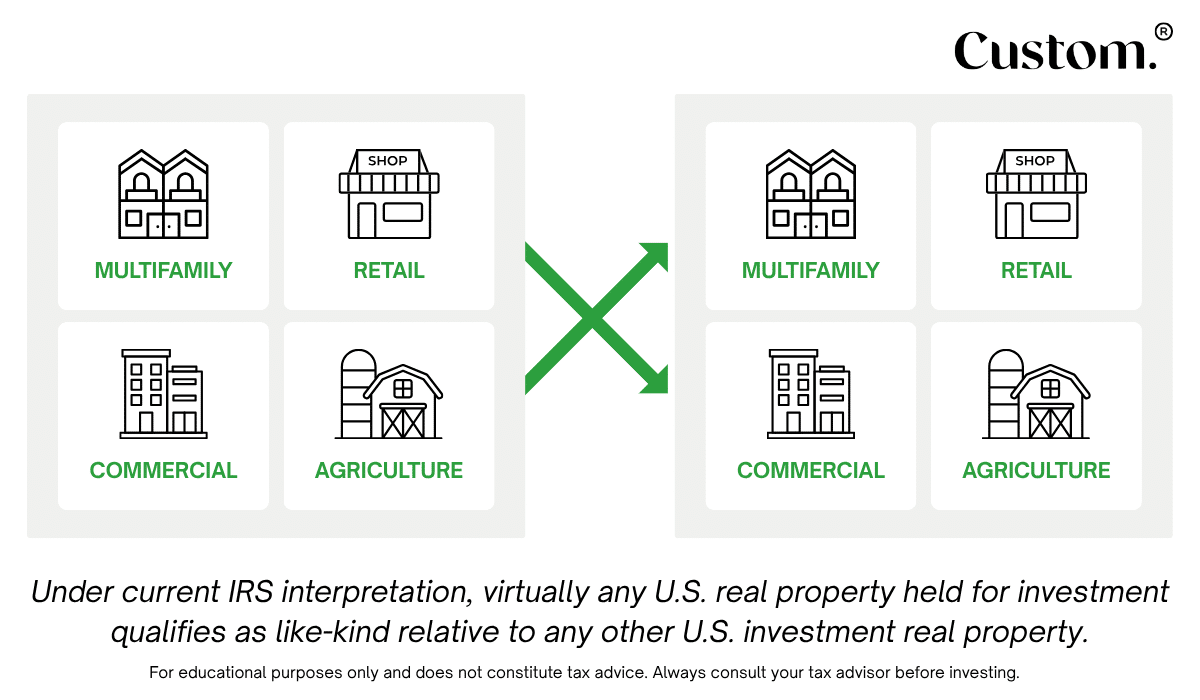
What matters is the nature and character of the property as investment real estate, not its specific type or grade.
For busy investors who are sick of actively managing individual properties, a 1031 exchange is often the ideal moment to upgrade asset quality by moving from active-management-intensive property (multifamily, mixed-use) into passive-income structures like absolute NNN commercial real estate.
How Do the 1031 Exchange Timeline Rules Work?
The 45-day and 180-day deadlines are the most operationally critical aspects of a 1031 exchange and also the most commonly violated. Missing either deadline by a single day forfeits your deferral and triggers full tax liability.
Here’s exactly how the timeline works:
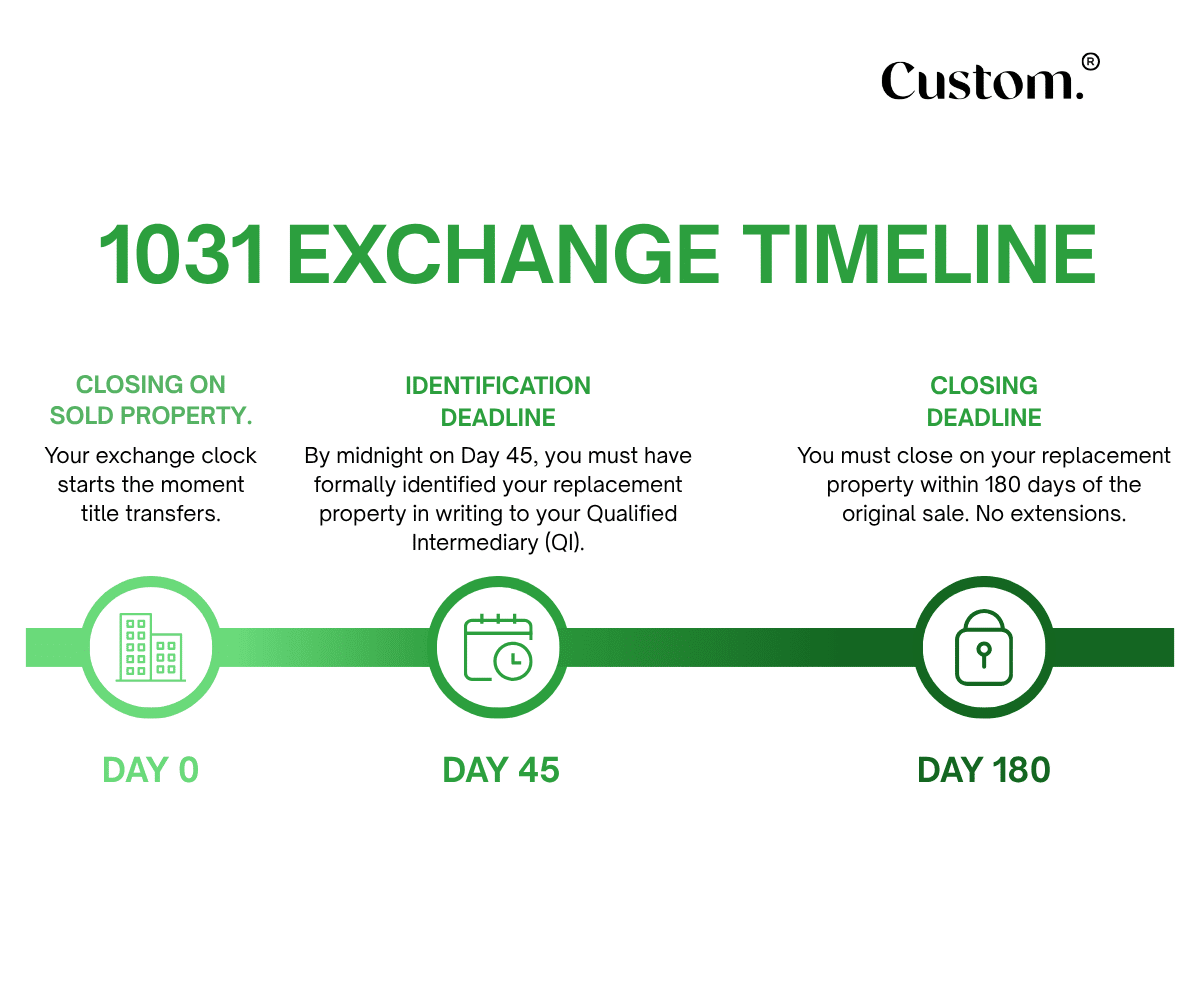
Day 0: Closing on the relinquished (sold) property. Your exchange clock starts the moment title transfers.
Day 45: Identification deadline. By midnight on Day 45, you must have formally identified your replacement property in writing to your Qualified Intermediary (QI). No extensions are granted.
Day 180: Closing deadline. You must close on your replacement property within 180 days of the original sale. This is an absolute deadline. No extensions are granted simply because a deal fell through or financing was delayed.
The 3 1031 Identification Rules You Need to Know
Identification must be specific (legal description, street address, or distinguishing property information) and submitted in writing to your QI before the 45-day deadline. Three rules govern how many properties you can identify:
- ▸3-Property Rule: Identify up to three properties of any value. Most straightforward.
- ▸200% Rule: Identify any number of properties, but their combined fair market value can’t exceed 200% of the relinquished property’s value.
- ▸95% Rule: Identify any number of properties of any total value, but you must close on at least 95% of the total identified value. Rarely used due to difficulty.
What Is a Qualified Intermediary and Why Does It Matter?
A Qualified Intermediary (QI) is the non-negotiable infrastructure of a valid 1031 exchange. Without one, you don’t have a 1031 exchange. You have a taxable sale.
Here’s why: the IRS requires that you never have “constructive receipt” of the proceeds from your sale. That means the funds from the relinquished property sale cannot touch your personal or business accounts at any point during the exchange.
A few critical rules about QIs:
- ▸Your attorney, CPA, real estate agent, and financial advisor are all disqualified persons and cannot serve as your QI.
- ▸The QI must hold your funds in a segregated account, ideally a qualified escrow or qualified trust.
- ▸There is no licensing requirement for QIs at the federal level. Quality varies enormously, so always verify that your QI carries adequate insurance and has an established track record.
In practice, the QI selection and engagement timeline is where many investors lose leverage. The QI must be in place and the exchange agreement signed before closing on the relinquished property. Engaging your QI the day before closing is not early enough.
What Properties Work Best as 1031 Replacement Targets?
In theory, any U.S. investment real property qualifies. In practice, not all replacement properties are created equal. The 180-day clock creates operational pressure and certain asset types consistently outperform others in exchange contexts.
Why Absolute NNN Properties Are Our Preferred 1031 Vehicle
Absolute NNN (net net net) leases are structured so the tenant pays all property expenses including taxes, insurance, and maintenance. This makes them disproportionately popular as 1031 replacement targets.
The 45-day timeline pressures you to find a deal quickly. NNN properties with investment-grade tenants, executed leases, and existing financing relationships are (almost by definition) difficult to find at the last minute. Investors who use NNN acquisitions as their primary 1031 vehicle build pipelines in advance, not in reaction.
From a financing standpoint, lenders prefer absolute NNN deals. The lease structure provides predictable, contractually guaranteed income that satisfies debt service coverage requirements cleanly.
From a tax perspective, an absolute NNN lease requires virtually no active management, which means the investor isn’t inadvertently converting passive income into active income — a distinction that matters significantly for tax treatment.
How Do You Calculate the Tax Deferral in a 1031 Exchange?
Here’s a clean illustration. Suppose you purchased a commercial property for $800,000. You sell it for $1,500,000, generating a realized gain of $700,000. Without an exchange, you’d potentially owe:
- ▸Federal long-term capital gains tax (20% for high earners): $140,000
- ▸Net Investment Income Tax (3.8% NIIT): $26,600
- ▸State capital gains tax (varies by state, 0–13.3%): variable
- ▸Depreciation recapture (25% on depreciation taken): variable, often $50,000–$100,000+
Total tax liability on a $700,000 gain can exceed $200,000–$250,000 in high-tax states. That capital, preserved through a 1031 exchange, remains deployed and compounding in your replacement asset.
The Stepped-Up Basis Benefit: The Ultimate Exit
What makes 1031 exchanges particularly powerful for long-term wealth building isn’t the individual exchange. It’s the combination of chained exchanges with the estate tax stepped-up basis rule.
When a property owner dies, the cost basis of their real estate “steps up” to the fair market value at date of death. Heirs who sell the property immediately after inheriting it owe no capital gains tax on any appreciation that occurred during the decedent’s lifetime.
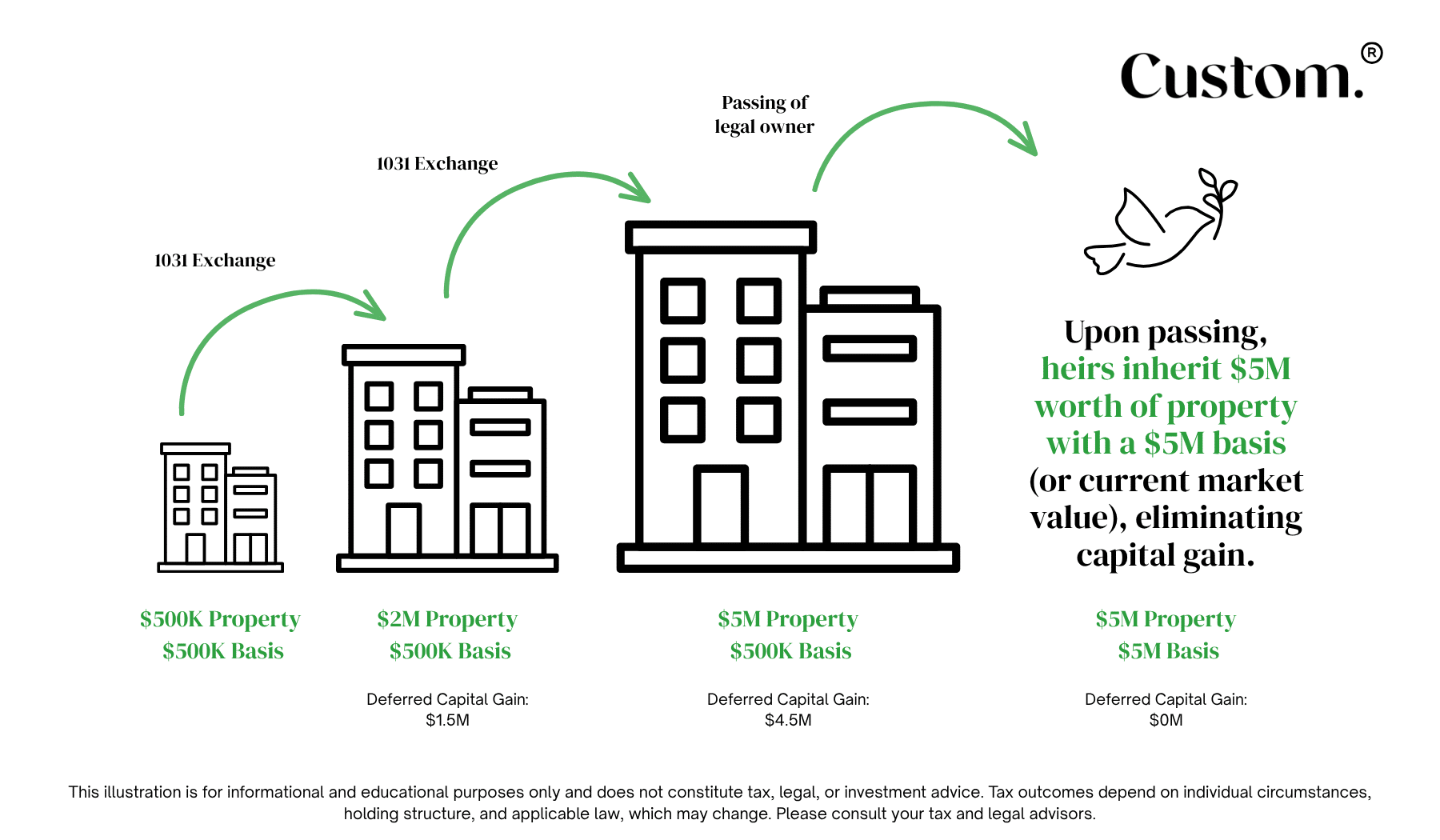
That means an investor who buys a property for $500,000, exchanges into increasingly larger assets over 30 years, and dies holding $5,000,000 in real estate will pass that $5,000,000 to heirs with zero embedded capital gains tax liability.
This is how long-term, tax-efficient real estate ownership is structured for generational transfer.
What Are the Most Common 1031 Exchange Mistakes?
Most failed exchanges fail for operational, not strategic, reasons (Equity Advantage, 2024). Understanding where investors go wrong is as important as understanding the rules themselves.
Mistake 1: Engaging a QI too late. The exchange agreement must be executed before closing on the relinquished property. Post-closing engagement is too late. Engage your QI the moment you have a signed purchase agreement.
Mistake 2: Missing the 45-day identification window. Investors underestimate how fast 45 days passes when you’re actively sourcing replacement property. Build your shortlist before your sale closes, not after.
Mistake 3: Receiving “boot” without planning for it. “Boot” refers to any non-like-kind property or cash you receive in an exchange, including mortgage relief if your replacement property carries less debt than your relinquished property. Boot is taxable.
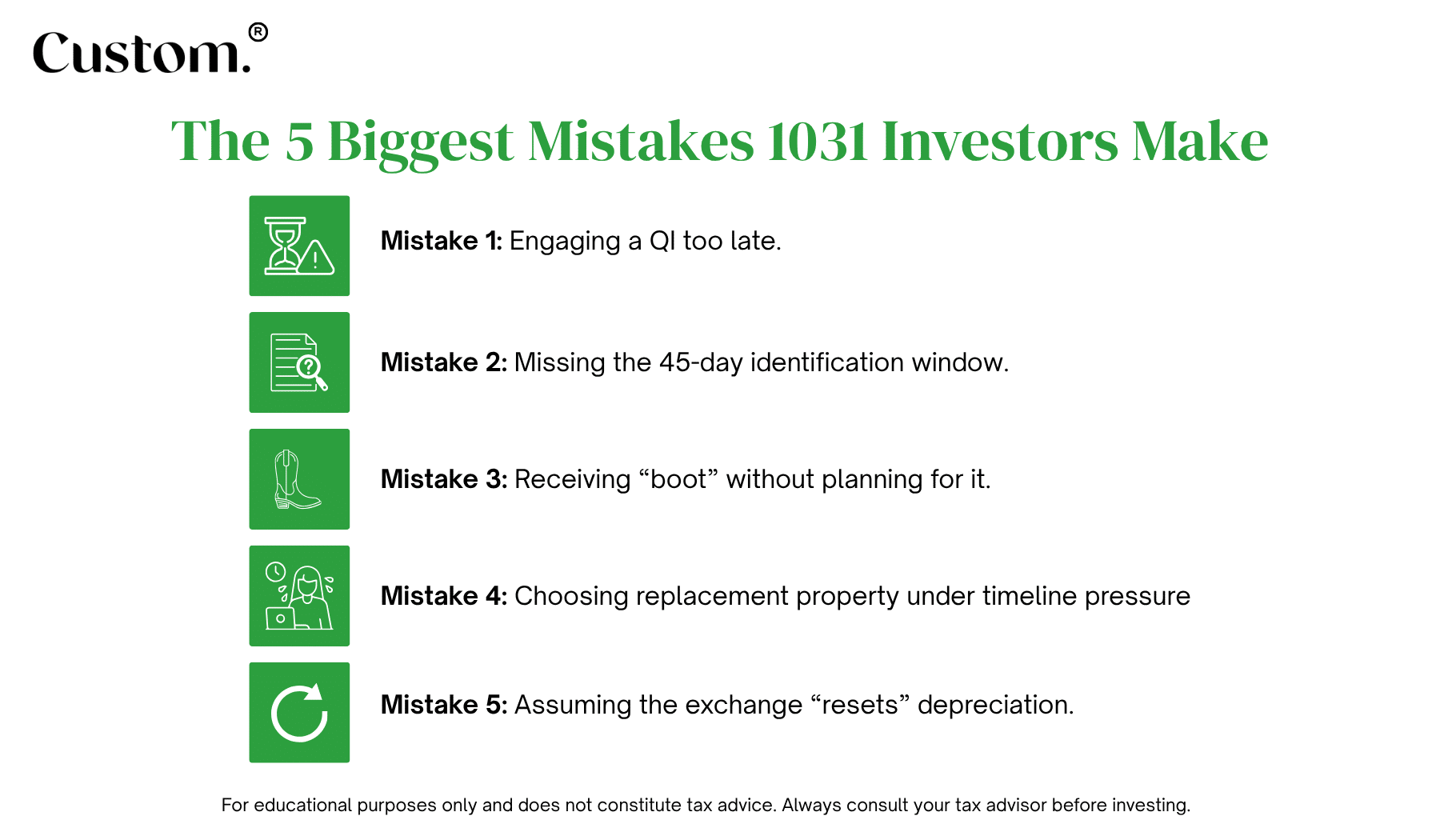
Mistake 4: Choosing replacement property under timeline pressure. The 180-day window creates psychological pressure to close on something. Investors who prioritize meeting the deadline over underwriting the deal often end up with poor-quality replacement assets.
Mistake 5: Assuming the exchange “resets” depreciation. It doesn’t. Your depreciation basis in the replacement property carries over from the relinquished property, adjusted for boot. This affects your ongoing depreciation deductions and depreciation recapture exposure at exit.
How Does a 1031 Exchange Work With Financing?
The 1031 exchange rules govern the equity treatment of your proceeds, but most investors are also financing their replacement acquisition, which adds another layer of operational complexity (Bankrate).
Your loan doesn’t need to equal your relinquished property’s loan. You’re required to reinvest the equity (the net proceeds your QI holds), not replicate the exact debt structure. However, if your replacement property carries less debt than your relinquished property, the difference in mortgage relief may constitute taxable boot.
Lender pre-approval before your sale closes. Given the 180-day clock, beginning the lender qualification process before your relinquished property closes isn’t optional. It’s standard operating procedure.
Debt service coverage ratios (DSCR) become your friend in NNN deals. Lenders underwriting an absolute NNN replacement property are working from a contractually defined income stream. That clarity typically produces cleaner, faster underwriting than deals with variable income.
What Is a Reverse 1031 Exchange?
A standard exchange requires you to sell first, then buy. A reverse exchange allows you to acquire the replacement property first, then sell the relinquished property. This gives you control over the acquisition timeline at the cost of additional structural complexity.
The IRS does permit reverse exchanges, but they’re more complex and expensive. An Exchange Accommodation Titleholder (EAT), typically an affiliate of your QI, holds title to either your replacement or relinquished property during the exchange period.
Reverse exchanges are particularly useful when a specific replacement property becomes available and you aren’t yet ready to sell, or when the replacement market is competitive and waiting to identify property post-sale creates meaningful risk of missing a deal.
The same 180-day clock applies, but it runs from when the EAT acquires the parked property.
How Does a 1031 Exchange Interact With Cost Segregation?
Cost segregation is an IRS-sanctioned engineering analysis that accelerates depreciation on commercial real estate by reclassifying building components from 39-year straight-line depreciation into 5, 7, or 15-year property. The result is significantly front-loaded depreciation deductions.
The combination of 1031 exchanges and cost segregation is one of the most powerful tax-efficiency strategies available to commercial real estate investors. When you exchange into a new property, you inherit the adjusted basis from your prior exchange — but you’re also acquiring a new property, which means you can commission a new cost segregation study on the replacement asset and generate a new wave of accelerated depreciation deductions.
According to a study by the American Society of Cost Segregation Professionals, cost segregation studies on commercial properties valued between $1M–$5M typically identify 20%–40% of the purchase price as accelerated depreciation-eligible components.
Frequently Asked Questions About 1031 Exchanges
Can I do a 1031 exchange on my primary residence?
No. Section 1031 applies only to property held for investment or productive use in a trade or business. Your primary residence doesn’t qualify. However, Section 121 of the tax code provides a separate exclusion for primary residence gains (up to $250,000 single / $500,000 married).
What happens if I miss the 45-day identification deadline?
Your exchange fails. The full proceeds held by your QI are released to you, and the entire gain from your relinquished property sale becomes taxable in the year of the sale. There are virtually no exceptions.
How many times can I do a 1031 exchange?
There is no legal limit on the number of 1031 exchanges an investor can execute over their lifetime. Serial 1031 exchangers who chain multiple exchanges over decades represent a significant share of all commercial real estate transaction volume.
Do I have to reinvest ALL the proceeds, or just some?
To defer 100% of your capital gains tax, you must reinvest 100% of the net sale proceeds into the replacement property. If you reinvest less by keeping some cash, the retained amount is “boot” and is taxable.
Can a 1031 exchange be used for a Delaware Statutory Trust (DST)?
Yes. The IRS issued Revenue Ruling 2004-86, which confirmed that beneficial interests in properly structured DSTs qualify as like-kind replacement property under Section 1031. DSTs allow fractional ownership of institutional-grade real estate and are frequently used as 1031 replacement vehicles.
The Strategic Case for Pairing 1031 Exchanges With Absolute NNN Acquisitions
A common commercially attractive use of a 1031 exchange is trading higher-management or appreciation-capped assets for institutional-grade NNN commercial properties.
Absolute NNN properties are a natural fit:
- ✓A lease structure where the tenant handles taxes, insurance, and all maintenance
- ✓Contractually defined income streams that may extend years or decades, depending on lease terms
- ✓Corporate-guaranteed or investment-grade-backed obligations
- ✓Lender-friendly profiles that close cleanly within exchange timelines
- ✓Minimal landlord responsibility, which matters both for quality of life and for passive income classification
For investors who’ve spent years managing tenants, units, or active commercial buildings, a 1031 exchange into an absolute NNN property often represents the first time their real estate actually runs itself.
What Does a Well-Executed 1031 Exchange Look Like in Practice?
The following example is illustrative only. Specific dollar amounts, timelines, and tax outcomes vary by transaction, jurisdiction, and individual circumstances. Consult your own tax advisor.
Consider an investor who acquired a multifamily property in 2015 for $600,000. By 2026, the property has appreciated to $1,800,000 and the investor is tired of tenant management, maintenance calls, and the operational overhead of active real estate ownership.
Through a properly structured 1031 exchange:
- ▸The investor engages a QI before listing the property.
- ▸Simultaneously, they begin evaluating absolute NNN replacement targets in the $1.5M to $2.5M range, targeting corporate-guaranteed tenants with 10+ year lease terms remaining.
- ▸The multifamily property closes. Day 0 begins.
- ▸By Day 40, three specific NNN properties have been formally identified to the QI.
- ▸Financing is already in process. The investor pre-qualified based on their financial profile and the NNN income stream before the exchange began.
- ▸By Day 150, the replacement NNN property closes. All proceeds reinvested. Tax deferred.
The investor now owns an absolute NNN asset producing cash flow from Day 1 of ownership, requires no active management, and carries a deferred tax liability that may never be paid.
If they hold until death, it passes to heirs with a stepped-up basis.
Ready to explore how a 1031 exchange could work within your current portfolio? Custom Capital sources, underwrites, and acquires absolute NNN commercial properties, providing buyers the timeline discipline and acquisition pipeline that 1031 exchanges require.
Schedule a Discovery Call to Review Your Exchange Options →
Disclaimer: This article does not constitute an offer to sell or a solicitation of an offer to buy any securities or investment products. Any statements regarding projections, anticipated results, or financial outcomes are illustrative only and are not guarantees of future performance. Consult a qualified tax advisor, attorney, and financial professional before executing a 1031 exchange.
Conclusion
A 1031 exchange is one of the most powerful wealth-compounding tools in the U.S. tax code.
The mechanics aren’t complicated, but the plan can be. 45 days to identify a property. 180 days to close on that property. A Qualified Intermediary in place before you close. Replacement inventory already in view before your sale closes.
Investors who treat the 1031 exchange as a portfolio strategy rather than a reactive tax tactic use each exchange as an opportunity to upgrade asset quality, simplify their ownership experience, and position their estate for a stepped-up basis exit.
The absolute NNN asset class was practically designed for this outcome.
This post is provided for informational and educational purposes only and does not constitute an offer to sell or a solicitation of an offer to buy any securities or investment products. Custom Capital does not act as a fiduciary, investment adviser, or broker-dealer. All investments involve risk, including the possible loss of principal. Returns, cash flow, and performance metrics referenced are illustrative and not guaranteed. Any investment opportunity, if offered, would be made only through definitive legal documentation and in compliance with applicable securities laws. Investors should consult independent legal, tax, and financial advisors before making investment decisions.